
The ‘Good Enough’ Home Decluttering System
A daily, weekly and all-day rhythm for people who are exhausted, overwhelmed, or have ADHD.
The problem with most home management advice is that it’s written for people with full tanks. Tidy this, deep-clean that, follow this 47-step system. For anyone running on low energy — whether from exhaustion, overwhelm, depression, or ADHD — that kind of advice doesn’t just fail. It actively makes things worse, because it becomes another thing you’re not doing right.
This system is built differently. It’s designed around one core idea: small, consistent actions throughout the day are far more sustainable than big irregular efforts. And when those small actions become automatic, they stop costing energy at all.
There are three layers: an all-day rule set, a daily rhythm, and a weekly one-job-per-day plan. You don’t need to do everything. Start with what you can, and build from there.
Layer 1: The all-day rules
These aren’t tasks on a list — they’re habits that run in the background all day. Each one is small. Together, they prevent the build-up that creates overwhelm.
Don’t put it down — put it away
This is the single most impactful habit in this entire system. Every time you pick something up or finish using it, it goes back to its home before you sit down, move rooms, or get distracted. Not on the bench. Not on the stairs. Home.
For ADHD brains especially: the moment you put something down “for now,” it is gone. It will live on that bench forever. Putting it away immediately removes the second decision entirely.
Touch it once
Related to the above: deal with things the first time you encounter them. Mail gets opened and sorted (not piled). Clothes go in the hamper or back on the hanger (not the floor). Dishes go into the sink or dishwasher (not the bench). One touch, done.
The ‘10-minute rule’ for paralysis
When starting feels impossible, set a timer for 10 minutes and work on one thing only. When the timer goes off, you can stop — guilt-free. The goal is not to finish. The goal is to start. Most of the time you’ll keep going. But if you don’t, 10 minutes of action is still infinitely better than none.
One room, one task
Pick a room. Pick one task in that room. Do it. Leave. Do not drift into other rooms mid-task. This is especially important for ADHD, where drifting leads to four half-started jobs and a more chaotic home than you started with.
Pair tasks to anchors
Attach chores to things you already do automatically. Wipe the basin while brushing your teeth. Empty the dishwasher while the kettle boils. Feed the washing machine before you sit down with breakfast. When a habit is already running, it costs almost nothing to attach another small action to it.
Visible beats invisible
Print this system. Put it on your fridge. Set phone reminders. Write tasks on a whiteboard. If it’s only in your head, it doesn’t exist — especially under stress or with ADHD. Externalise everything.
Layer 2: The daily rhythm
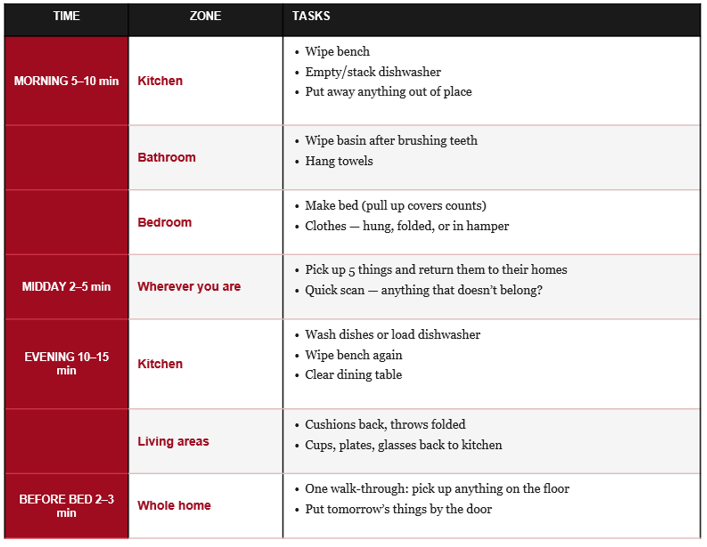
Four short windows throughout the day. Total time: around 20–30 minutes. Each window has a location, a time investment, and specific tasks. The goal is to reset the home to baseline — not to make it perfect.
M
A note on the midday reset: this is the most skippable one, and the most underrated. Two minutes of picking up 5 things prevents the evening feeling overwhelming. If you’re at home, do it. If you’re not, skip it without guilt.
Layer 3: The weekly one-job plan
One job per day. Nothing more. Each job takes 10–20 minutes maximum. By spreading tasks across the week, no single day requires a big effort — and the home stays in a consistent, liveable state.
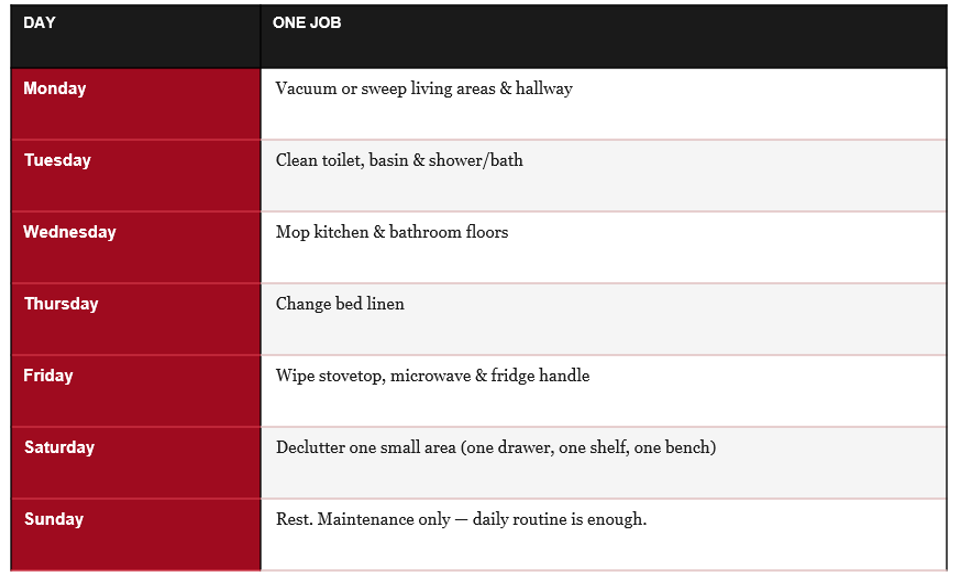
Rest. Maintenance only — daily routine is enough.
Sunday is a rest day by design. The daily rhythm is enough. Rest is not optional — it’s part of the system.
For ADHD specifically
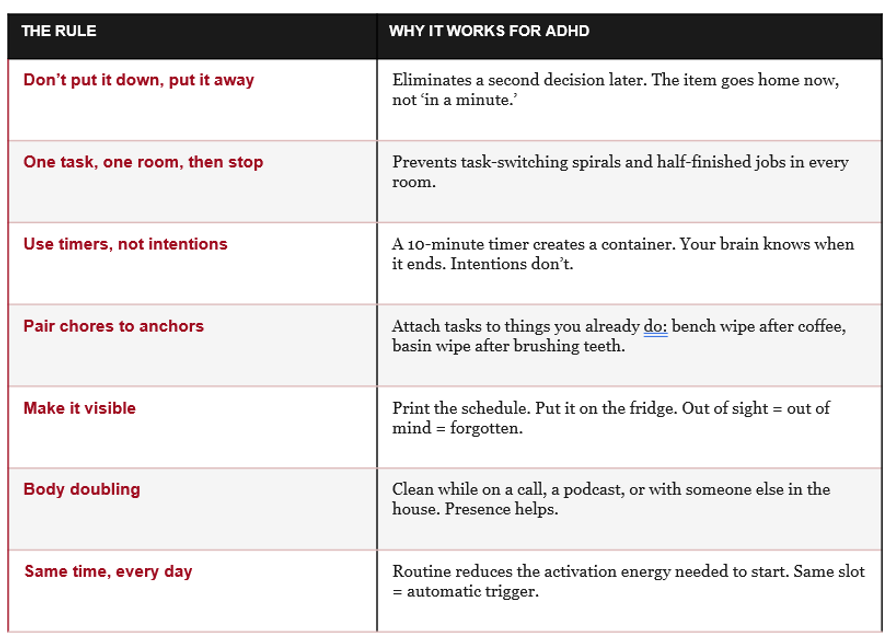
Everything above applies — but here’s a quick reference of why each rule matters for an ADHD brain, and the specific mechanism that makes it work.
A note on shame
ADHD is not a motivation problem or a laziness problem. It’s a self-regulation and executive function problem. Messy homes are one of the most common and least talked-about sources of shame for people with ADHD — not because they don’t care, but because the standard systems weren’t built for how their brains work. This one is.
When the system isn’t working
If you’ve tried systems like this before and they collapse after a few days, it’s worth asking: what’s actually getting in the way?
Sometimes the answer is practical — the system needs adjusting. But sometimes the answer is that your nervous system is carrying more than a cleaning schedule can fix. Persistent inability to maintain daily routines, chronic overwhelm, and the exhaustion that doesn’t lift even when things are tidy — these are worth looking at more closely.
That’s the kind of work I do with people.
Ready to work on what’s underneath?
I support people who are exhausted in ways that rest doesn’t fix, using trauma-informed, body-based therapy. Based in Adelaide, South Australia.
→ Book a session at sunetgopaul.com
Sunet Gopaul | Trauma Therapist & Expat Coach | Adelaide, South Australia | sunetgopaul.com